Remember when SEO was just about stuffing keywords into a meta tag and hoping for the best? Those days are long gone.
Today, a new guest is checking into the digital landscape.
They aren't "Googling" for a hotel; they are asking ChatGPT, Perplexity, or Google’s AI Overviews to "find a boutique hotel in downtown San Diego with a rooftop bar and great Wi-Fi."
If your hotel doesn't show up in that AI-generated answer, you don't exist to that traveler.
This is the era of Generative Engine Optimization (GEO)—or as I like to call it, "Digital Insurance" for your property. If you’re a "Stressed-but-Ambitious" GM, you’ve likely noticed your organic traffic shifting. You’re worried about being replaced by an AI summary.
Good news: You won’t be. But you do need a new playbook. Let’s break down how to optimize your hotel for the AI revolution.
From "Blue Links" to "AI Answers": The Big Shift
For twenty years, the goal of hotel SEO was to be the first "blue link" on page one. But AI search engines don’t give the user a list of links; they give a recommendation.
This is what industry experts call SGE for hospitality marketing (Search Generative Experience). Instead of a guest browsing ten websites, the AI crawls the web, analyzes data, and presents the "best" options in a conversational summary.
Why should you care? Because if the AI can’t "read" your hotel’s data, it can’t recommend you. Relying on fragmented, outdated technology is a "hidden tax on your profit" that makes your hotel invisible to these new engines.
What is GEO (Generative Engine Optimization) for Hotels?
As AI Is Reshaping Hotels, the way travelers discover and book accommodations is evolving beyond traditional search. Think of GEO for hotels as the technical bridge between your physical property and an AI’s brain. While traditional SEO focuses on keywords, AI optimization focuses on machine-readable hotel data.
AI engines are essentially "Pattern Recognizers." They look for structured, verified, and authoritative information to build their answers. If your website is built on a "rusty cleaver" of disconnected systems, the AI will likely hallucinate or ignore you entirely.
To rank, you need a unified digital foundation that connects your reservations, operations, and marketing into one clean stream of data.
The 5 Pillars of AI Optimization for Hotels
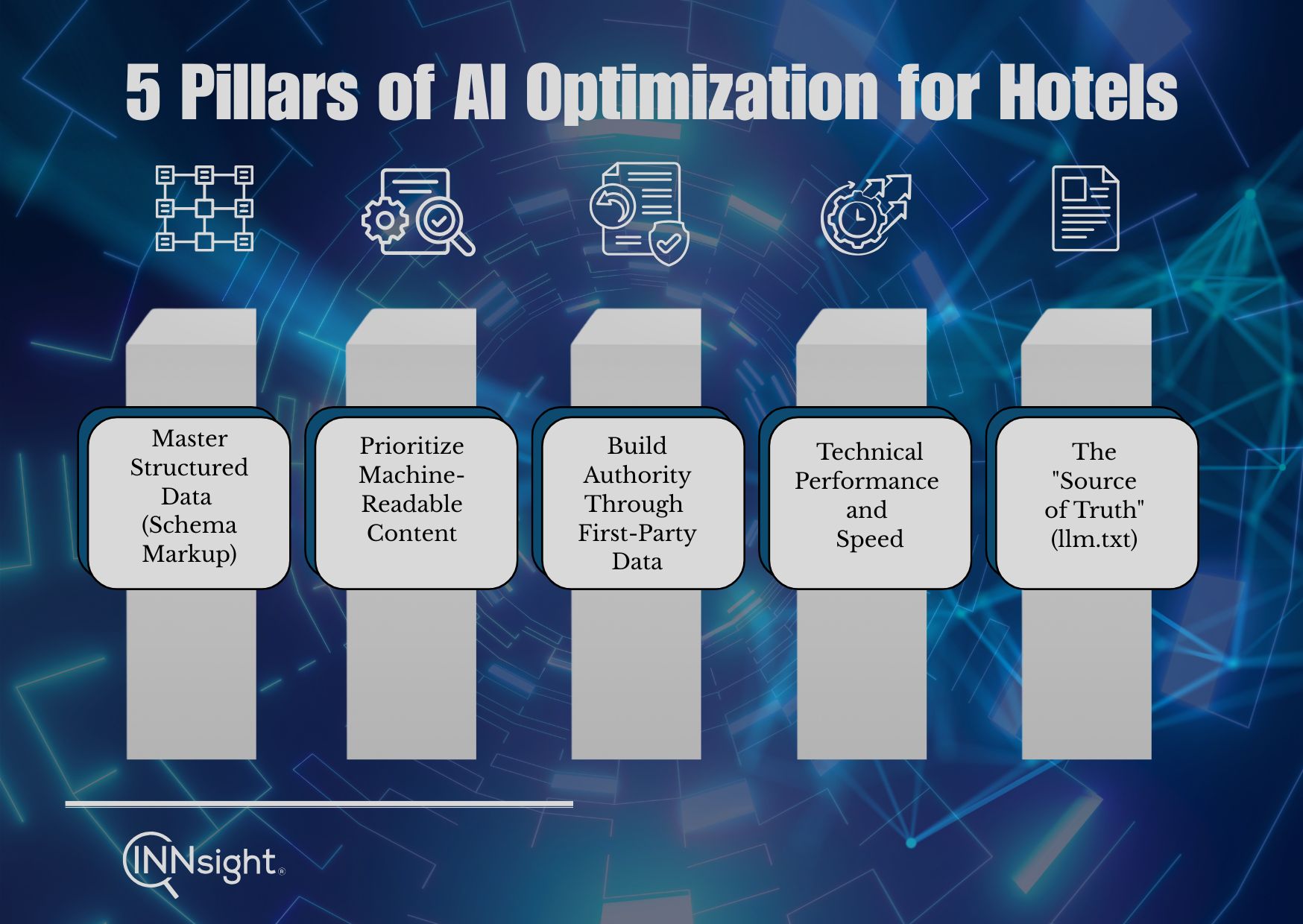
How do you actually "talk" to an AI? You don't need a computer science degree; you need to master these five pillars.
1. Master Structured Data (Schema Markup)
This is the single most important technical step. Schema markup is a specific code you add to your website that tells the AI exactly what it’s looking at.
Instead of the AI guessing you have a pool, Schema confirms it.
- Room types and pricing.
- Amenities (Wi-Fi, gym, parking).
- Local attractions and distance.
- Review snippets.
2. Prioritize Machine-Readable Content
AI models love "Entity-based" content.
Instead of writing "We are a great hotel," write "Our hotel is located 0.5 miles from the San Diego Convention Center." Use clear, factual headers.
AI engines prefer high-intent, SEO-optimized websites that are built to answer specific traveler questions.
3. Build Authority Through First-Party Data
AI search engines prioritize trust.
One of the best ways to build this is by leveraging guest data from your PMS to create authentic content.
When you own the guest relationship rather than relying on OTAs, you can generate the kind of "Experience and Expertise" (E-E-A-T) signals that AI models crave.
4. Technical Performance and Speed
If your site takes five seconds to load, the AI crawler might move on.
A modern, all-in-one platform doesn't just manage rooms; it ensures your website hosting and digital marketing services are lightning-fast and technically sound.
5. The "Source of Truth" (llm.txt)
As AI agents become more common, many hotels are adopting an llm.txt file.
This is a simple text file on your server that provides a "Direct Feed" of your hotel’s facts (check-in times, pet policies, etc.) specifically for AI models to read without distractions.
The 2026 AI Optimization Checklist for Hotels
Don't have time to learn the code? Hand this checklist to your web developer or audit your current PMS provider.
If they can't check these boxes, you're losing money to the "fragmented tech" hole.
- Audit Your Schema: Does every room type have unique Schema markup?
- Google Business Profile: Is your profile 100% complete and synced with your website?
- Site Speed Check: Does your site load in under 2 seconds on mobile?
- FAQ Section: Do you have an FAQ page that answers conversational questions (e.g., "Do you offer free airport shuttles?")?
- Review Integration: Are your 5-star reviews being fed into your website as structured data?
- Unified Data: Is your PMS, Booking Engine, and Website all part of a single, integrated platform?.
Why an Integrated PMS is Your Secret AI Weapon
You might be wondering: "What does my Property Management System have to do with AI search?"
Everything.
A fragmented system—one for reservations, one for housekeeping, one for marketing—creates "data silos".
If your marketing tool thinks you have a rooftop bar but your PMS doesn't show it in the amenity list, the AI gets confused.
A modern, all-in-one Property Management System like INNsight acts as the "Single Point of Truth". By unifying your operations, you ensure that every digital signal your hotel sends out is consistent, accurate, and ready for an AI to digest.
Not only does this "future-proof" your hotel against search changes, but it also helps realize a 30% reduction in operational waste.
When your team isn't stuck doing manual data entry or "paper-chasing" audits, they can focus on what actually drives reviews: Hospitality.
Conclusion: Don't Just Rank—Directly Convert
Ranking in AI search is only half the battle.
Once the AI recommends you, you need to ensure the guest books directly with you to avoid that "OTA Commission Tax" of 15% to 25%.
By driving organic, "free" traffic from AI search engines directly to your commission-free booking engine, you aren't just cutting costs—you're building a more profitable, independent future. As the Future of Hotel Technology continues to evolve with AI-powered search, conversational booking experiences, and smarter guest discovery, hotels that invest in direct booking strategies today will be better positioned to increase revenue, strengthen guest relationships, and reduce their dependence on online travel agencies.
Ready to see if your hotel is AI-ready? Let’s stop the leaks and start growing.
Book a Free Demo of the INNsight PMS
Author
Raj Patel
CEO & Founder
Raj Patel, the driving force at INNsight, is changing the game for hotels with his real-world expertise in software and digital marketing. Drawing on his Silicon Valley experience at eBay, Raj keeps things practical. Think of practical tools that work, making hotels shine online and turning digital success for every hotel. Jump on board the INNsight journey, where Raj's hands-on approach brings a touch of reality to revolutionizing the hospitality scene.
Follow him me LinkedIn



 Related Blogs
1.jpg "Top Challenges Small Hotels Are Facing in 2026 (And How to Overcome Them)")