Summary
AI in hospitality is reshaping how hotels attract, serve, and retain guests in 2026. From smart pricing and chatbots to hyper-personalized marketing and AI-powered search optimization, technology is driving the future of hotel operations and SEO. In this blog we explore how AI helps enhance guest experiences, improves efficiency, and elevates online visibility—while also highlighting challenges like data privacy and over-automation. For hoteliers, embracing AI is now essential; and the right time is now!
Introduction
These days, hotels must do more than have a good location or an impressive lobby to attract guests. Nowadays, travelers begin their journeys with a simple online search. It could also be a voice-controlled command or a personal recommendation.
And guess what?
AI in the hotel industry is increasing at the heart of how those searches are understood.
Also, how those recommendations are made. For hoteliers, AI is no longer background noise. It's the soundtrack to the future. It makes guest experiences seamless, operations more intelligent, and online visibility sharper than ever.
How AI in Hotel Industry is Revolutionizing Its Operations
Today, AI is a critical co-pilot for navigating the competitive hospitality landscape.
From the moment a potential guest thinks about booking to the time they check out, AI in hotel industry starts weaving its magic. It is often behind the scenes that creates a better experience for everyone.
Hotel businesses that use AI-driven SEO strategies are well-prepared for effective performance. It is time for us to go beyond the old way of thinking. It's time to start using the opportunities of AI in hospitality industry.
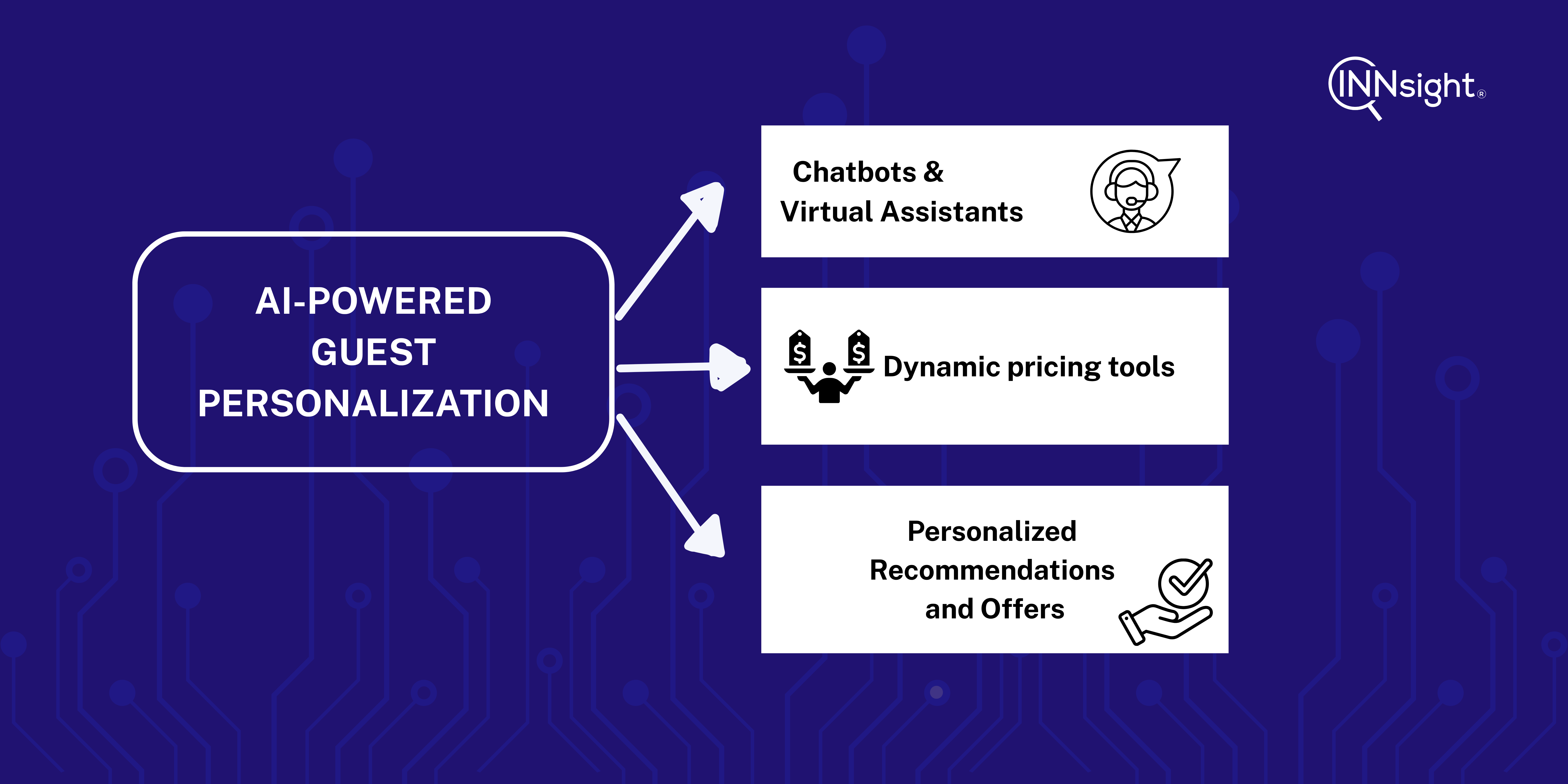
AI-Powered Guest Personalization
Consider a guest who requests a room facing the city and without feather pillows. What if your system can predict this need and present the answer before they ask? This is an example of how personalization of AI in travel and hospitality works. And it is truly groundbreaking. AI analyzes different data points to identify what makes each guest unique. In other words, it’s about ensuring the content speaks to each person, not just everyone. Major hotel brands are beginning to use AI to analyze their loyalty program data.
If a guest usually books executive suites, the AI in hotel industry can offer a discounted upgrade on their next corporate stay. Or it can suggest local business amenities they might appreciate. This level of foresight builds loyalty and makes guests feel valued.
It's like having a mind-reader for your guests!
AI-Powered Chatbots & Virtual Assistants
Remember waiting on hold for a simple question? Those days are fading fast.
AI-powered chatbots and virtual assistants are today's 24/7 digital concierge. These smart programs can handle a vast array of guest inquiries - from checking room availability and answering FAQs about amenities (like "Does your hotel have a pool?") to processing simple booking requests.
Think of a guest arriving late at night with a question about room service.
An AI chatbot can immediately provide the menu, hours, and even take the order. This frees up your staff to focus on more complex guest needs, leading to happier employees and more satisfied guests.
Dynamic Pricing Tools For Revenue Optimization
For a long time, hotels have adjusted rates, but AI technology in hospitality industry has made this process much more sophisticated.
Dynamic pricing tools, powered by artificial intelligence (AI), analyze real-time data points.
For example, factors such as changes in demand, competitor rates, local events, weather predictions, and social media sentiment can cause these shifts.
Say there's a concert or sports event in your city, an AI system will pick up the demand change and slightly raise room rates. During slow periods, it may be set to reduce rates. This will encourage more people to book, preventing rooms from being left empty.
It’s not only about increasing prices. But, about picking the right price at any moment to make your hotel stand out and earn profits.
Personalized Recommendations and Offers
Beyond booking, AI in hotel industry excels at recognizing opportunities to enhance guest experience and boost your bottom line. Based on a guest's profile and real-time behavior, AI in hotels can offer personalized upsells and cross-sells.
Did a guest check in and mention they're tired?
The system might suggest a spa package or a complimentary late checkout for their next stay.
If a guest booked a standard room, AI might notice they often spend more on dining or activities. Noticing this, it could offer a tailored upgrade to a suite with a dining credit or a discount on local tours.
This isn't pushy sales; it's anticipating needs and offering solutions that truly resonate. It's about giving guests exactly what they want, sometimes before they even know they want it.
Streamlining Hotel Management
AI is not limited to customer service. It is also helping hotels become more effective in areas that are not visible.
Automated Housekeeping and Maintenance Scheduling
Keeping the housekeeping tasks arranged for a large hotel is quite challenging. AI for hotels can solve it.
With the help of data like guest check-out, the number of rooms occupied, and when the workforce is available, AI schedules work efficiently. As a result, rooms are cleaned more smoothly, so guests have to wait less, and staff members receive fewer overtime hours. If a guest has an early check-in request, the AI can instantly reprioritize that room for cleaning.
Enhanced Security and Surveillance
Your hotel security is paramount, and use of AI in hospitality industry is adding an extra layer of vigilance.
AI-powered surveillance systems go beyond simply recording footage. They can analyze real-time video streams to detect unusual behavior. Even identify unauthorized individuals in restricted areas, or even spot unattended luggage.
As an example, an AI system can be taught to detect a suspicious person loitering or a vehicle parked in the wrong place. It can also signal security officers for a preemptive action. This reduces the need for continuous human monitoring. In turn, this makes security personnel more efficient and responsive. It's not simply about getting bigger; it's about getting smarter, with security.
How Does Generative AI Impact Hotel Search Results?
Generative AI is a buzzword that's reshaping how we interact with technology. And its influence on hotel search results is profound. This has evolved beyond finding information; it's creating new, personalized experiences.
What is Generative AI and Its Benefits for Hotels?
Generative AI refers to AI systems that can create new content – text, images, audio, video – based on the data they've been trained on. Consider large language models (LLMs), such as those powering ChatGPT. For hotels, AI-generated content SEO means exciting new possibilities.
Think of an AI that can write persuasive descriptions of your hotel rooms. The benefits include:
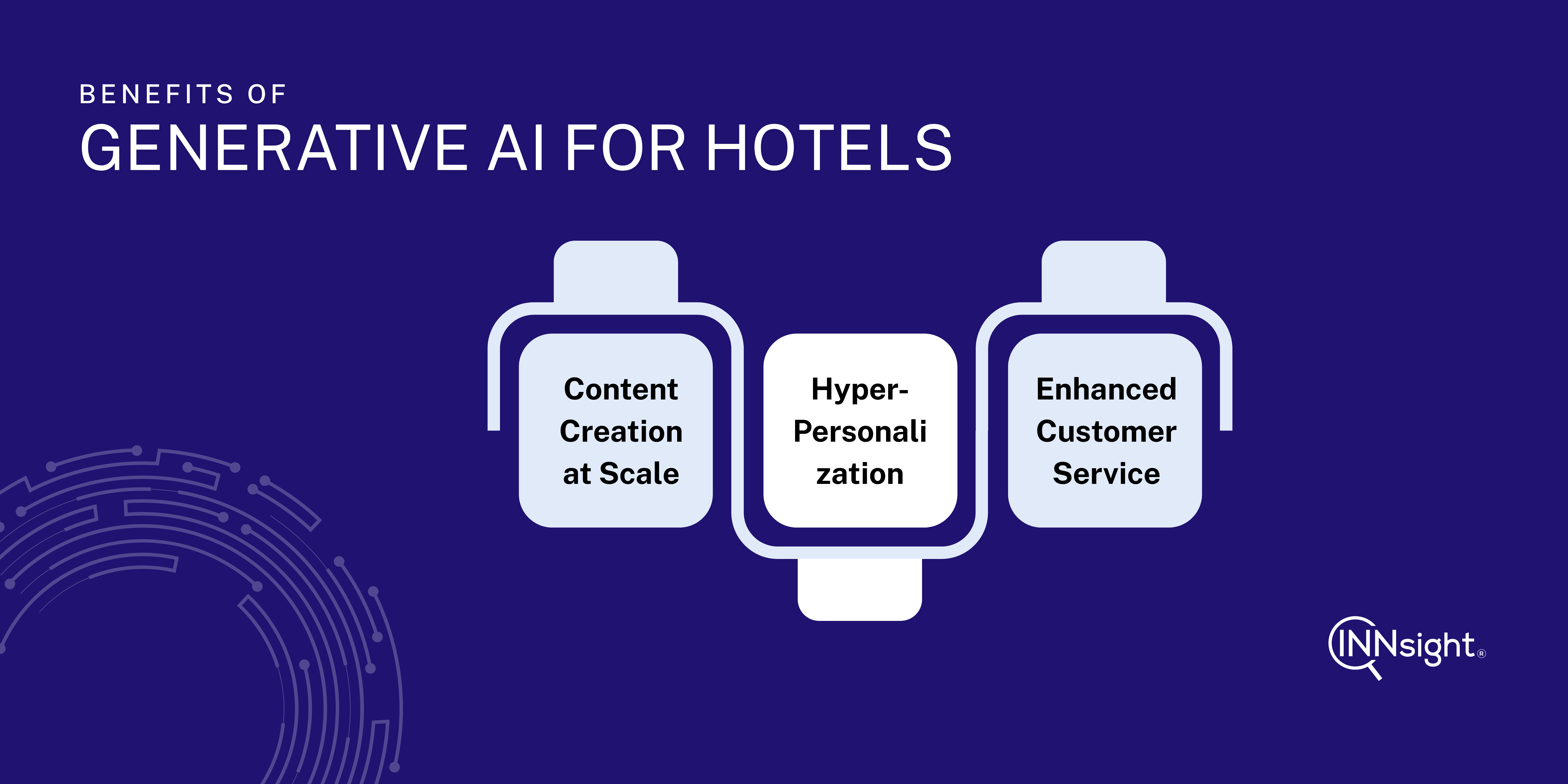
1. Content Creation at Scale
Create original and excellent content on your websites, blogs, and marketing materials.
2. Hyper-Personalization
Create personalized messages or guest offers.
3. Enhanced Customer Service
Create instant, natural-sounding responses to complex guest queries and improve their satisfaction.
4. Competitive Edge
It's your time to stand out in a crowded market by offering tailored digital experiences. Have a dedicated AI-creative team working for you around the clock!
How to Utilize Generative AI for Hotel Marketing?
This is where the rubber meets the road for hoteliers. You can use Generative AI's powerful marketing tools for greater visibility and guest bookings.
1. Personalized Email Marketing
Leverage generative AI to craft individualized email campaigns. "We understand that you enjoyed our spa the last time you were here, so here's a special deal on our new wellness package. Only for you!"
2. Catchy Social Media Posts
AI will be able to come up with imaginative yet relevant content for your social media platforms. It all depends on the platforms and the groups of audiences.
3. Localized Content Generation
If your hotel is located near a specific landmark, AI in SEO can generate blog posts or FAQs about that landmark. All the while incorporating your hotel's proximity and offerings. This helps you capture more localized searches.
How to Optimize Hotel Websites for AI Search Engines?
To win the visibility game in 2026, your hotel's website needs to speak AI's language. This means moving beyond just keywords and thinking about intent and conversation.
Proven Strategies to Boost Hotel Visibility on AI Search Platforms
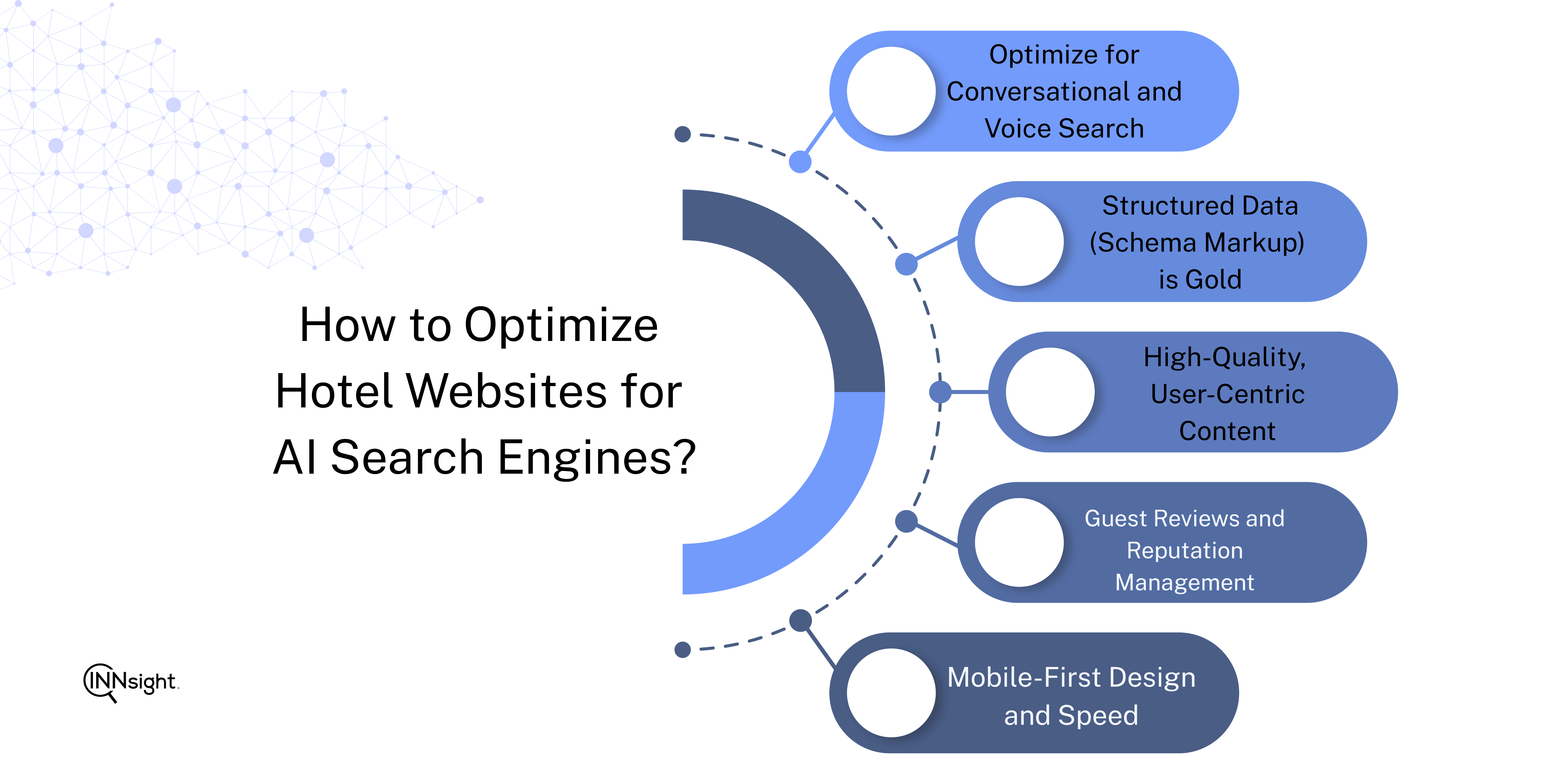
AI-powered search engines are smarter, more conversational, and more intuitive. Here's how to make sure your hotel shines:
Optimize for Conversational and Voice Search
People are using natural language and voice commands to search. Consider how guests phrase their queries. Use FAQs on your website to answer common questions in a direct, natural way.
Structured Data (Schema Markup) is Gold
AI systems love structured data because it helps them understand your hotel's information. Implement schema markup to tag details. Add your hotel details for AI to display them on search results or AI-generated summaries.
High-Quality, User-Centric Content
Your content needs to be richer and more helpful than ever. AI prioritizes informative, engaging content and provides answers to user queries.
Guest Reviews and Reputation Management
AI-powered search engines often factor in social proof and reputation. Encourage guests to leave reviews. And you need to respond to all, positive and negative, showing that you value those. This builds trust with both potential guests and AI algorithms.
Mobile-First Design and Speed
AI search engines favor websites that are fast and optimized for mobile devices. Most travelers search on their phones, so a seamless mobile experience is non-negotiable. Ensure your website loads fast and is easy to navigate on any screen size.
What is the Role of Traditional SEO in an AI-Driven World?
While AI in hotel industry brings new strategies to the forefront, it doesn't mean we throw out the SEO playbook. Traditional SEO principles remain the foundational pillars upon which AI-driven strategies are built.
You might also question: Is Traditional SEO Still Relevant in an AI-Driven Search Landscape?
The answer is: Absolutely, yes!
Traditional SEO elements like keyword research, technical SEO (site speed, mobile-friendliness, crawlability), link building, and content quality are vital. AI doesn't invent information; it interprets and synthesizes existing data.
Traditional SEO provides the framework, and AI provides the intelligence to optimize within that framework. They are not mutually exclusive; they are synergistic.
Understanding how AI SEO optimization impacts your hotel's online performance is crucial for refining your strategies and demonstrating a return on investment.
How to Analyze AI-Driven Search Results for Hotels?
Measuring the impact of AI on your hotel's SEO requires a keen eye on evolving metrics and an understanding of how AI-generated search results are presented.
Monitor AI Overviews (SGE)
Google's Search Generative Experience (SGE), or "AI Overviews," provides AI-generated summaries in search results.
Analyze if your hotel's content is being featured in these summaries. If not, revisit your content to ensure it's informative with clear headings and structured data.
Track Conversational Search Queries
Pay attention to the types of long-tail, conversational queries that lead users to your site. Tools like Google Search Console can help identify these.
Analyze Voice Search Data
While direct voice search analytics can be challenging, monitor how voice searches might be driving traffic to your localized content or FAQs.
Are guests asking questions that your AI chatbot can answer, and is that leading to bookings?
Review Direct Bookings from AI-Assisted Channels
If your AI chatbot or virtual assistant facilitates bookings, track the conversion rates from these interactions. This will help you get a sense of the ROI of your AI investment.
Sentiment Analysis of Reviews
AI-powered sentiment analysis tools can process guest reviews and feedback across platforms. This assists you in comprehending the mood of the guests and finding out common topics so that you may provide solutions to guest problems and enhance guest satisfaction, which also affects your online reputation and search engine optimization (SEO).
Website Analytics (Beyond Basic Metrics)
Dive deeper than just traffic. Look at user behavior on your site after AI-driven searches: bounce rate, time on page, pages per session.
Are users finding what they need quickly? Are they engaging with your content?
Challenges and Considerations for Adoption of AI in Hotel Industry
Although the opportunities provided by AI are enormous, its adoption is not hassle-free. You should be considerate of these problems to secure an effective integration.
Data Privacy and Security Concerns
AI in hotel management feeds off of data, and particularly personal guest data. This brings up serious privacy and security issues. Hotels gather sensitive data - names, addresses, payments, preferences. The most important thing is to ensure high-level data encryption, storage security, and compliance with regulations such as GDPR and CCPA.
Over-reliance on AI vs. Human Touch
While AI can automate many tasks, hospitality is inherently a "people business." Over-reliance on AI in hotels can lead to a dehumanized guest experience. Guests still crave genuine human interaction, empathy, and personalized service from staff.
For example, a chatbot can answer FAQs, but a friendly front desk agent makes a lasting impression. AI can manage housekeeping schedules, but a thoughtful housekeeper can leave a handwritten note. Striking the right balance is crucial.
Avoiding AI-generated Content Penalties
Search engines, particularly Google, are becoming increasingly sophisticated at identifying AI-generated content. While using AI in hotel industry to assist with content creation is acceptable, relying solely on unedited, low-quality AI content can lead to SEO penalties.
Google emphasizes "helpful content" created for humans, not just algorithms.
Human Oversight and Editing: Always review and refine AI-generated content. Add your unique brand voice, local insights, and personal touch.
Fact-Checking: AI can sometimes provide inaccurate information. Always fact-check any AI-generated content before publishing.
Focus on Value: Ensure your AI-assisted content provides genuine value to your target audience, answers their questions, and stands out from the competition. Don’t let AI make your content bland or generic.
Future Trends: AI and Hotel SEO Beyond 2026
Beyond 2026, we can expect even more transformative changes, further cementing AI and hospitality roles in operations and SEO.
Hyper-personalized Marketing with Generative AI
We’ve seen personalization, but hyper-personalization takes it to another level.
Imagine generative AI creating unique virtual tours of a room tailored to a specific guest’s preferences, or dynamic landing pages that adapt content based on their browsing history and demographics. AI will not only suggest a spa treatment but might even create a personalized video message from the spa director.
It's about speaking directly to the individual, not the crowd.
AI-Powered Voice Booking Dominance
Voice search is already here, but AI will drive voice booking to new heights.
Guests will be able to seamlessly book rooms, request amenities, and make dining reservations using natural voice commands, directly through smart speakers, in-room voice assistants, or even their car's infotainment system.
Hotels that integrate advanced AI voice assistants capable of handling complex conversations and facilitating direct bookings.
Imagine: "Book me the usual room at Hotel [Your Name] for next weekend." The AI handles it all. This will help capture a significant portion of this growing market.
Google’s Evolving Algorithms Favor AI-Augmented Content
Google’s algorithms are constantly evolving, and they are increasingly designed to understand and reward content that is genuinely helpful, authoritative, and user-centric.
That is, AI-enhanced content that is more accurate, deeper, and personalized. However, at the same time, a more human and unique perspective with insightful views will be preferred.
AI will help hotels create content that Google's complex algorithms love, making your hotel more discoverable than ever. It's not about tricking the system; it's about making your content as smart and useful as possible.
Conclusion
The landscape of hotel operations and online visibility is rapidly changing, and Artificial Intelligence is undeniably the driving force. For hoteliers, embracing AI in hotel industry isn't just about keeping up; it's about leading the way.
The future is here, and it’s intelligent!
Now is the time to start looking and incorporating AI tools into your hotel operations and marketing strategy. With AI on your side, you will be able to create memorable guest experiences, optimize operations, and make sure your hotel stands out in the digital landscape of 2026 and beyond.
Author
Roshan Patel
CEO & Founder
Meet Roshan Patel, the dynamic force propelling INNsight to new heights. As a co-founder, his pragmatic and cost-focused leadership shapes the company's technical strategy and product architecture, ensuring a seamless hotel digital experience. With a hotel management and technology background, Roshan is a driving force in providing INNkeepers the tools they need to economically showcase their properties to cost-conscious travelers. Roshan's impact goes beyond tech, raising INNsight as a game-changer in hotel digital marketing.
Follow him on LinkedIn



 Related Blogs

.jpg "LLM Seeding for Hotels: How to Program Your Property into AI Recommendations")